Filler — Contouring Has Limits and Risks That Cannot Be Taken Lightly
Filler — Contouring Has Limits and Risks That Cannot Be Taken Lightly. DIVA Poipet explains How does filler work? and Common indications.

Filler is commonly an injectable volumising substance used to add volume, refine contours, or support certain hollow areas. This group of procedures can create rapid change, but also carries serious risk when the product, indication, or technique is unsuitable.
- How does filler work?
Most popular fillers contain hyaluronic acid with different degrees of cross-linking and properties. Some are soft and suit areas that need natural movement; others provide stronger support for structure. Product selection needs to be based on the area, injection layer, and objective.
One millilitre of filler does not create the same result across every product and every location. It should not be compared only by price per cc.
- Common indications
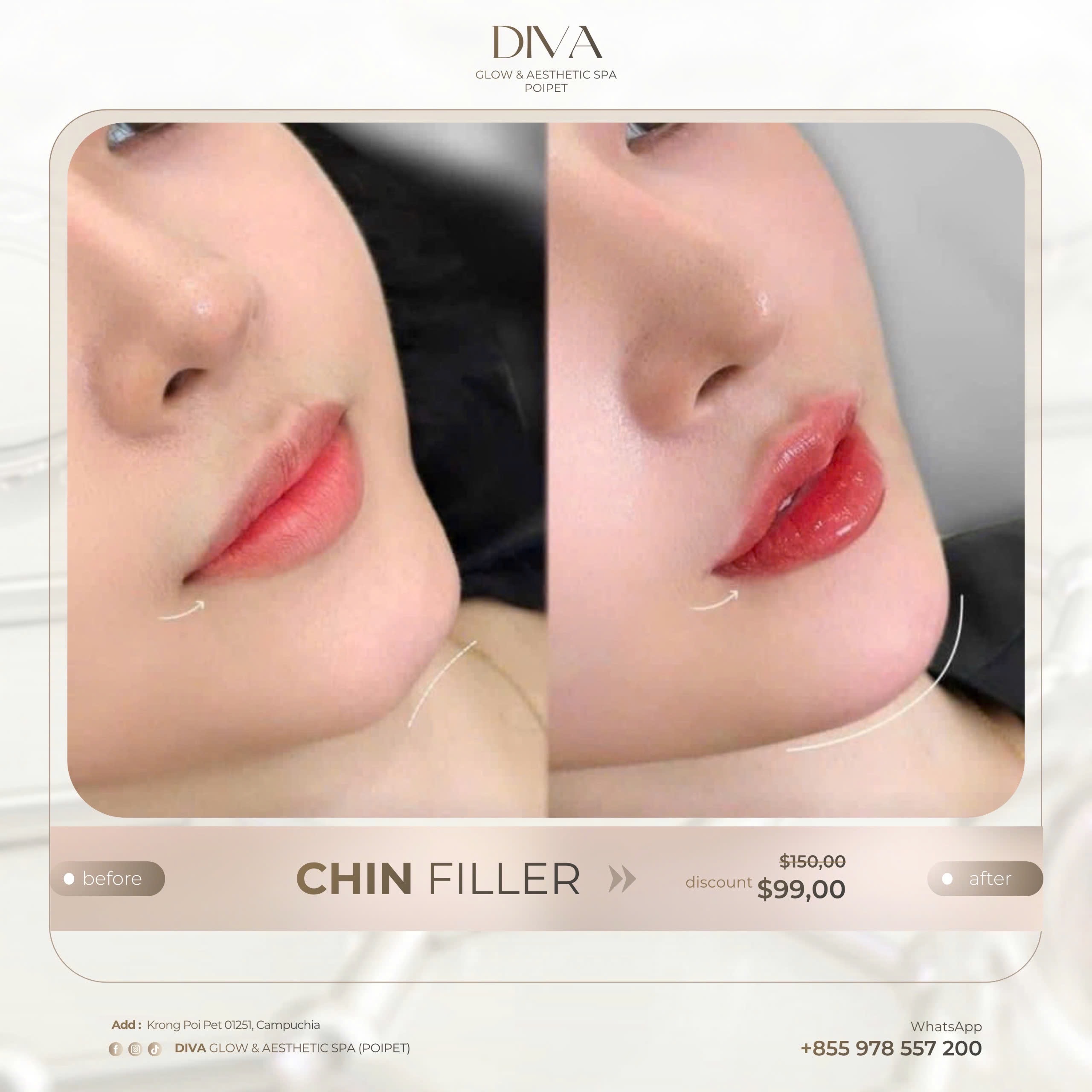
Filler may be considered for the lips, chin, folds, temples, cheeks, or other areas with volume loss. In some cases, filler helps balance facial contours and makes the face look less tired.
However, not every hollow area should be filled. Sagging, muscle pull, thin skin, and bone structure may require another method or a combination.
- Situations to avoid or approach with caution
Injection should not be performed when there is infection, inflammation, open lesions, or a history of reactions requiring assessment. Products with an unclear origin, transferred to another container, or stored under unknown conditions should not be used.
High-risk areas require a practitioner with anatomical knowledge and a complication-management plan. Procedures should not be performed only because a client wants to resemble a reference image.
- Limitations
Filler does not lift all sagging tissue, reduce jaw muscles, or improve surface quality like skin booster. Excessive injection can make the face look heavy, puffy, or out of natural proportion.

Results are not permanent and filler can change over time. Some products can be dissolved, but management is not always simple.
- Common reactions
Swelling, bruising, mild pain, and temporary asymmetry can occur for several days. The lip area commonly swells more visibly than some other areas.
Clients need to avoid arbitrary massage and should not judge the final result while swelling remains.
- Vascular occlusion — the most important risk
Filler can enter or compress a blood vessel, causing tissue ischaemia. Warning signs include severe pain, pale or purple skin, coldness, unusual colour change, mottling, or reduced vision.
This situation needs urgent management. For HA filler, hyaluronidase may be used within an appropriate protocol, but early detection and rapid response are very important.
- Product and records
Clients should be shown the box, label, expiry date, and batch number and should know which product is used. Records need to state the area, amount, product, and reactions.
Transparency is not only for marketing; it is necessary if follow-up or management is needed later.
- Combining filler
Filler can be combined with Botox, HIFU, skin booster, or skin technology, but the cause needs correct analysis. If the face lacks volume, filler has a role. If the concern is muscle activity or sagging, the main treatment force may be different.
- DIVA’s Perspective
At DIVA, filler is not sold as “how many cc for the whole face.” Every area needs a clear objective and limit. Large-volume filler is not performed in body areas or indications beyond safe control capacity.
Clients need to understand realistic results, risks, and management options before proceeding.
Conclusion
Filler can contour quickly, but it is not a simple procedure. Genuine products, anatomy, technique, records, and complication-management capacity are all important.
A beautiful result is not only one that looks fuller; it needs correct proportion, preserved natural function, and no unnecessary trade-off in risk.
Treatments & Technology
A deep, plain-language guide to the aesthetic technologies DIVA Skin Clinic Poipet uses — Pico laser, CO2 fractional, RF
Open→
What Is Pico Laser? Mechanism, Indications, Limitations, Recovery, and Combination
What Is Pico Laser? Mechanism, Indications, Limitations, Recovery, and Combination. DIVA Poipet explains How Pico laser
Open→
CO₂ Fractional — When Is It Suitable for Scars, Pores, and Skin Texture?
CO₂ Fractional — When Is It Suitable for Scars, Pores, and Skin Texture? DIVA Poipet explains How CO₂ Fractional works a
Open→
RF Microneedling — Deep Treatment, but Not Every Skin Type Is Suitable
RF Microneedling — Deep Treatment, but Not Every Skin Type Is Suitable. DIVA Poipet explains How it works and Common ind
Open→