New Technology — Exosomes in Skin Aesthetics: Current Potential and Limitations
New Technology — Exosomes in Skin Aesthetics: Current Potential and Limitations. DIVA Poipet explains Exosomes are not one uniform and Early evidence shows positive.
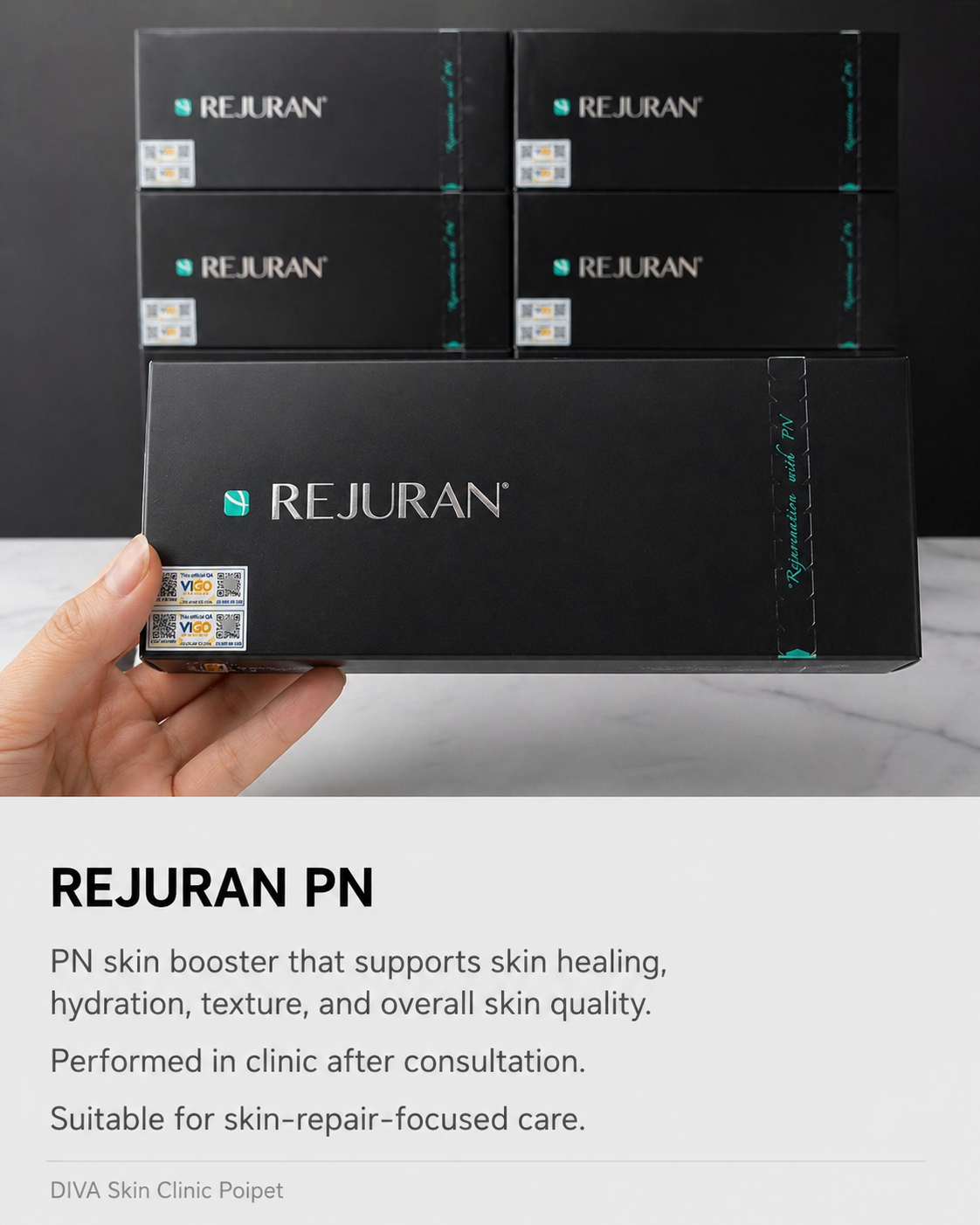
Exosomes are one of the fastest-growing keywords in aesthetics. Many products are promoted for recovery after laser, rejuvenation, reducing pigmentation, supporting scars, and stimulating hair growth. Some content even describes exosomes as an advance that could replace many traditional methods.
This interest is not entirely without basis. Exosomes are very small extracellular vesicles involved in signalling between cells. Preclinical research and some human studies have reported potential in wound healing, inflammation, regeneration, and aesthetics. However, current evidence still has important limitations.
- Exosomes are not one uniform product
Cell source, culture process, isolation, storage, and quality control can differ between manufacturers. For this reason, two products both labelled “exosome” may not have the same composition, purity, or activity.
Some products on the market may use the term exosome as a marketing label even when information about their biological characteristics is incomplete. Clients cannot assess a product only from attractive packaging or the advertised number of “billions of particles.”
- Early evidence shows positive signals
Reviews from 2024 and 2025 note that exosomes are being studied for skin rejuvenation, pigmentation, scars, and hair. Some small studies have shown improvement in wrinkles, elasticity, texture, or recovery after technology-based procedures.
However, many studies have few participants, non-uniform methods, and short follow-up periods. Results from one product or one mode of use cannot automatically be applied to every exosome product on the market.
- Potential does not mean standardisation has been achieved
Professional reviews emphasise the lack of common standards for production, isolation, identification, dosage, and delivery of exosomes into the skin. This is a major barrier to comparing studies and assessing long-term safety.
When a technology has not been standardised, clinics need to be more cautious in how they introduce it. Terms such as “proven beyond doubt,” “cell regeneration,” or “risk-free” should not be used.
- The route of use is an important issue
Applying a product to intact skin, applying it after laser, combining it with microneedling, and injecting it directly are completely different in terms of penetration and risk.
A 2024 review noted that, in the United States, exosomes used in aesthetics are not approved for injection in the way they are used in some other markets. Reviews from 2025 also emphasised that no exosome has been FDA-approved.
For this reason, seeing a product sold widely does not mean that every route of use has been confirmed by regulatory authorities.
- Risks need to be clearly explained
Risks may be related to contamination, unwanted inflammatory reactions, differences between batches, incompletely described contents, and difficulty tracing the source.
A 2025 review for dermatologists also discussed theoretical concerns such as promoting unintended disease processes. This does not mean that exosomes are certain to cause these problems, but it shows that long-term data are still insufficient to regard the products as completely safe.
- Exosomes do not replace diagnosis and indication
Clients with melasma need to distinguish the type of pigmentation, triggering factors, and likelihood of recurrence. People with scars need to identify scar structure. People with hair loss may need evaluation for medical causes.
Using exosomes as a “recovery product for every condition” can cause clients to overlook the main method that is actually needed.
- What should a clinic check before adding exosomes to its services?
The clinic needs to verify the manufacturer, source materials, quality documentation, storage conditions, batch number, expiry date, instructed route of use, and evidence for the exact product.
The clinic also needs to establish an informed-consent process, record-keeping, and monitoring of reactions. A product should not be purchased simply because it is popular or because many other clinics are promoting it.
DIVA’s Perspective
DIVA can follow exosomes as an important research trend, but should not turn them into a “miracle technology” message. When any recovery-support product is used, it needs to be clear that it is complementary and does not replace choosing the right laser, controlling inflammation, using sunscreen, and home care.
DIVA’s content should help clients understand the difference between “has potential,” “has early research,” and “has been standardised and approved for a specific indication.”
Conclusion
Exosomes are a promising field in skin aesthetics, and new research continues to emerge. However, the market is growing faster than standardisation and regulation.
A responsible clinic should neither reject every new technology nor turn early evidence into a promise. The most appropriate current approach is caution, transparency about limitations, and use only of products with a clear origin within a controllable scope.
Reference: PubMed reviews from 2024–2025 on exosomes in dermatology and aesthetics, including PMID 38226413, 39764639, 39761139, and 40256340.

Research & Aesthetic Updates
DIVA Skin Clinic Poipet only publishes research, technology and safety updates when the information is genuinely useful
Open→
Recent Research — Sleep Deprivation, Stress, and Acne in Night-Shift Workers
Recent Research — Sleep Deprivation, Stress, and Acne in Night-Shift Workers. Practical guidance and realistic next step
Open→
Technology Update — How Do Pico, CO₂ Fractional, and RF Microneedling Differ?
Technology Update — How Do Pico, CO₂ Fractional, and RF Microneedling Differ? Practical guidance and realistic next step
Open→
Safety Guidance — When Should Laser, Peel, or RF Microneedling Be Postponed?
Safety Guidance — When Should Laser, Peel, or RF Microneedling Be Postponed? DIVA Poipet explains The skin is unusually
Open→