Why does the skin still not improve after treatment at many different places?
Why does the skin still not improve after treatment at many different places? Practical guidance and realistic next steps from DIVA Skin Clinic Poipet.

Many clients come to DIVA after receiving treatment at several spas or clinics, or after trying many different methods. Some have had acne extraction, peels, laser, mesotherapy, recovery care, and multiple changes to their home product routines, yet their skin condition continues to recur.
At that point, clients often think their skin is too difficult to treat or that all previous methods were ineffective. However, the issue does not always lie in the technology or the quality of each provider. Many cases do not improve because treatment lacks continuity, lacks a clear goal, or because the methods have not been connected into an appropriate plan.
- Each place treats one part, but no one reviews the whole condition
One place may focus on acne extraction. Another may perform a peel. Another may recommend laser. The client may then buy additional products online for self-care at home.
Each method may have its own benefit, but without someone assessing the entire process, clients can easily receive conflicting directions.
For example, after laser treatment, recovery care and sun protection should be prioritised. But if acids or strong whitening creams are used at home immediately afterward, the skin may become irritated and treatment results may be affected.
Effective treatment does not depend only on each individual session. Treatment sessions, home products, and recovery time need to support one another.
- Changing treatment providers too early
Many clients expect to see a clear result after only one session. If the desired result is not achieved within a few days or weeks, they move to another provider and begin a new method.
However, acne, melasma, scars, pores, and pigmentation all need time to be monitored. Not every change appears immediately. Some methods require a recovery phase. Some conditions need to be stabilised before moving to a deeper treatment step.
When clients change continuously, the skin has not had time to adapt to the previous method before it receives a new one. The next practitioner also has difficulty evaluating accurately because there may be incomplete information about device energy, active ingredients, products, or previous reactions.
- Choosing services based on advertising rather than the skin's needs
One common reason clients receive treatment at many places without improvement is choosing services based on a device name or a promotional programme.
A client may see that Pico is popular and want Pico. They may see many CO₂ before-and-after images and want CO₂. They may see skin boosters promoted for a dewy look and want skin boosters.
However, each method is suitable only for certain concerns. Pico may support pigmentation, pores, and skin surface concerns when appropriately indicated. CO₂ may support scars and resurfacing, but it is not appropriate for every skin type to undergo immediately. RF microneedling may be suitable for texture and superficial scars, but inflamed skin or a severely weakened skin barrier needs careful assessment.
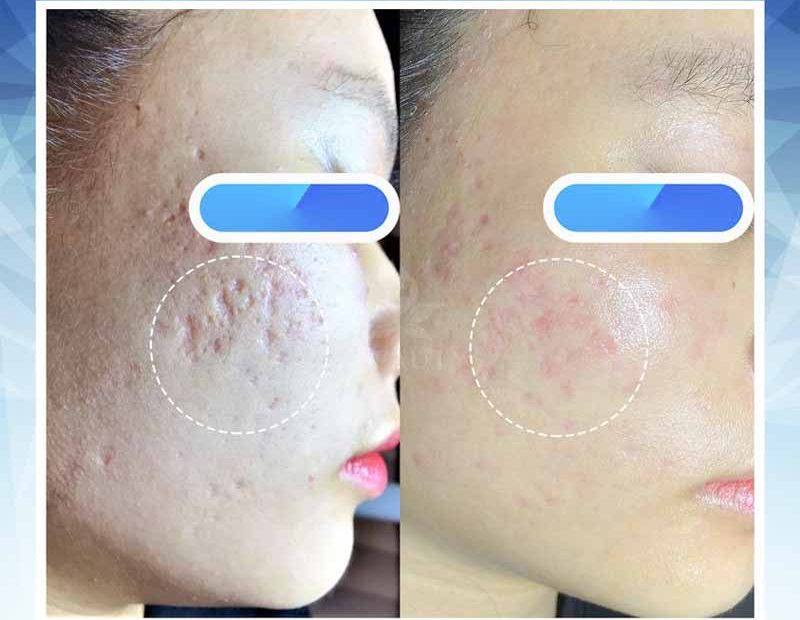
Even when a method is appropriate, results may still be poor if it is used at the wrong time.
- Not addressing the causes of recurrence
Acne extraction may make the skin surface cleaner for a short time. Laser may improve part of the pigmentation. Peels may help with congestion. But if the causes that keep creating the condition remain, the problem can continue to return.
The client may still work night shifts and sleep irregularly, use pore-clogging cosmetics, fail to use sun protection consistently, extract acne themselves frequently, use excessively strong acne products, or neglect skin care during the recovery period.
In-clinic treatment is only one part. If the client does not change their care routine or follow aftercare instructions, results are very difficult to maintain.
- Treatment is not continued for long enough
Many skin conditions cannot be fully resolved in one session. Acne needs time for inflammation to reduce, congestion to be controlled, and new lesions to be limited. Pigmentation needs monitoring of the skin response and sun control. Scars require repeated stimulation for remodelling. Sensitive skin needs time for its protective barrier to recover.
Some clients stop treatment as soon as their skin begins to stabilise. When acne returns later, they think the method was ineffective.
In practice, the maintenance phase and homecare are as important as the initial treatment phase.
- Expectations beyond what the method can achieve
Some clients want pores to disappear completely, deep scars to become flat after one treatment, or melasma to be gone permanently. These expectations can make clients dissatisfied even when the skin has improved.
Aesthetic treatment generally aims to improve the degree of a concern, control the condition, and help the skin surface become more stable. Results depend on the initial severity, individual biology, recovery time, care routine, and each person's ability to maintain the result.
- Not keeping a treatment history
When clients move between many providers, they often do not clearly remember which device was used, the energy level, which product was injected, which active ingredient was used for peeling, what reactions the skin had, or which products were used afterward.

A missing history makes it harder to choose the next method accurately. Some skin findings may result from previous treatment, but a new practitioner does not have enough data to distinguish them.
DIVA's Perspective
At DIVA, treatment does not begin with selecting a device. The first step is identifying which stage the skin is currently in.
Some skin needs inflammation control. Some needs recovery. Some is already stable and can undergo a deeper method. In some cases, all treatment needs to be paused temporarily so the skin can rest before reassessment.
DIVA also reviews treatment history, current products, previous reactions, and the client's ability to maintain homecare. Only then is a suitable first session selected.
The goal is not to perform the greatest number of services, but to select what needs to be done at the present time.
Conclusion
Receiving treatment at many places without improvement does not necessarily mean that every previous provider was wrong. The issue often lies in fragmented treatment, changing methods too quickly, choosing services based on advertising, failing to control the causes of recurrence, or having expectations that are too high.
The skin needs a treatment direction with proper order, adequate monitoring time, and coordination between in-clinic treatment and homecare.
Instead of continuing to look for another new method, it can sometimes be more important to pause, review the entire history, and identify exactly what the skin needs.
DIVA Insights & Poipet Skin Trends
Observations from DIVA Skin Clinic Poipet on how climate, border-town lifestyle, night-shift work and cross-border clien
Open→
Why do many people start developing acne after living in Poipet for a while?
Why do many people start developing acne after living in Poipet for a while? DIVA Poipet explains Night-shift work and i
Open→
Why does the skin keep getting worse despite using many products?
Why does the skin keep getting worse despite using many products? DIVA Poipet explains A product that suited the skin an
Open→
Why do clients choose treatment methods as if they were choosing food from a menu?
Why do clients choose treatment methods as if they were choosing food from a menu? Practical guidance and realistic next
Open→